Sometimes You Need Kirk. Sometimes You Need Spock.
I’ve been thinking about two different ways of making decisions.
In my head, I originally thought of them as two kinds of optimizers.
- The first looks at the current state, finds the best next move, executes, and repeats when the landscape changes.
- The second looks at a decision and asks: What risk does this create later? What becomes harder to change? What happens if this assumption is wrong? Are we closing an option we might need?
I was thinking of the first as a “local optimizer” and the second as a “global optimizer.”
That gives far too much credit to the second one.
In most interesting real-world problems, no one knows the landscape well enough to find a global optimum.
A better analogy (given by ChatGPT, yes, I didn’t come up with it, but I like it) is Kirk and Spock from Star Trek.
Kirk: make the best move, then recompute
Kirk’s advantage is not that he ignores the future. It is that he has confidence in his ability to adapt to it.
His strategy is approximately:
If tomorrow will give you better information than you have today, there is a strong argument for not spending too much today optimizing for tomorrow.
This is particularly powerful in startups and R&D.
You can spend weeks designing for a problem you think you will have in two years. Or you can solve the problem in front of you, wait for new information, and discover that your imagined problem never existed.
Kirk protects you from paying real costs for hypothetical futures.
But the strategy contains an assumption:
I will still be able to change direction later.
Sometimes that assumption is wrong.
Spock: this move changes the moves available afterward
Spock asks a different question.
Not simply:
What happens next?
But:
What does this decision make possible or impossible afterward?
Suppose we have two choices:
If we only care about the next state, A is obvious.
But imagine the transition structure looks like this:
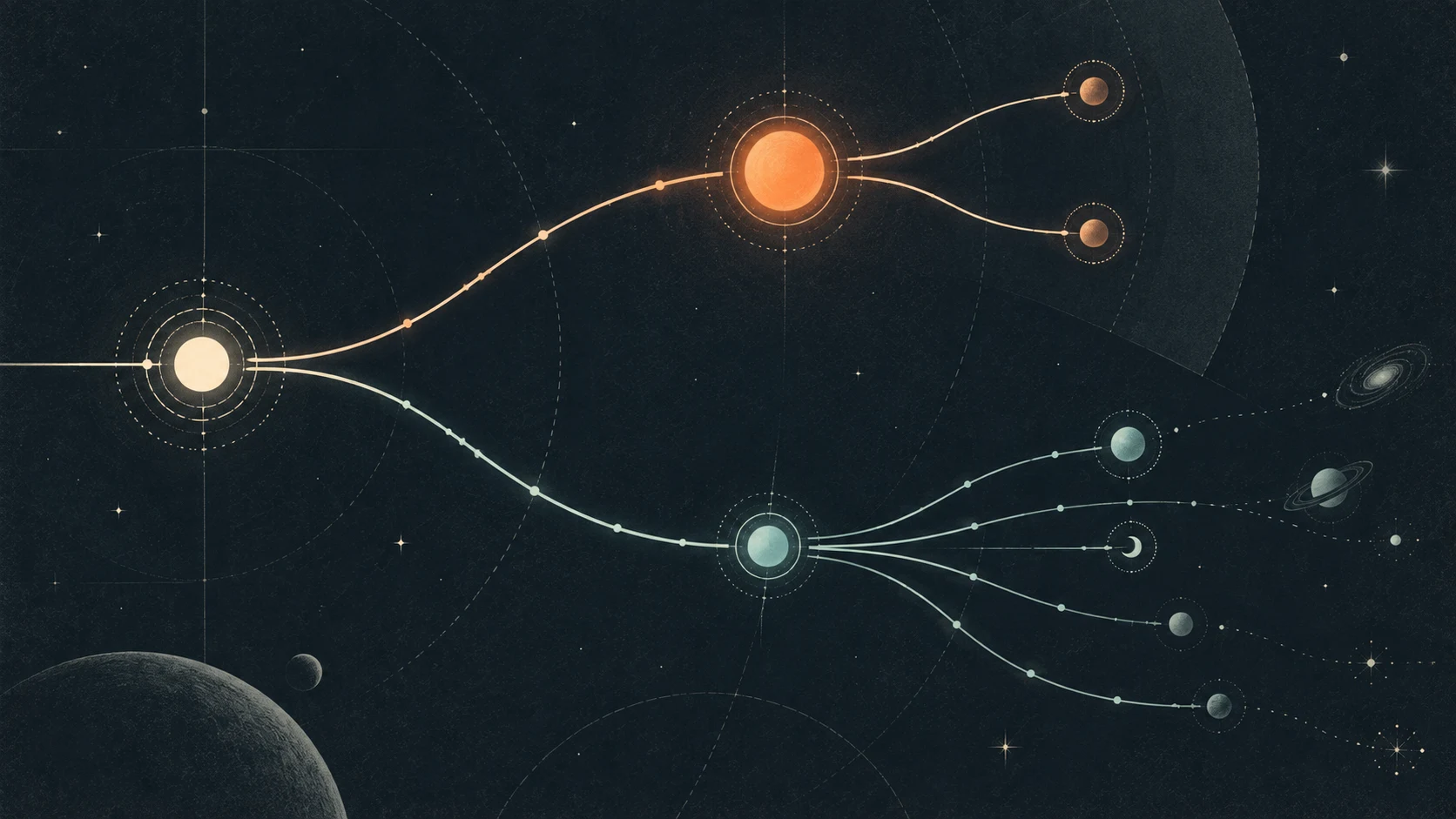
The important part is that we don’t actually need much predictive power here.
I don’t need to claim that 20 will happen. I don’t even need to know which of those future states is most likely.
I only need enough structural knowledge to see that choosing A gives us +2 today at the cost of removing several future paths.
Now the question becomes:
Is the extra value today worth the optionality we are giving up?
The important variable is reversibility
If a decision is cheap to reverse, Kirk is clearly a good approach.
Build it. Try it. Learn. Change it.
Then extensive analysis of hypothetical futures can easily become wasted work.
But some choices change the cost of every subsequent choice: architecture, security assumptions, data models, customer commitments, enterprise integrations, pricing precedents, regulatory decisions.
Spock’s question becomes increasingly important.
The argument is no longer:
I think this bad thing will happen.
It is:
I don’t know whether this will happen, but this decision makes it much more expensive to respond if it does.
Spock has a failure mode too
Seeing a risk does not mean you should protect against it.
Suppose avoiding some future constraint costs six weeks today.
The future state has a small chance of occurring.
Even if the risk has been correctly identified, protecting against it may still be a terrible decision.
Very roughly, the comparison is something like:
This is where Spock can fail.
A sophisticated model of an uncertain future can make that future feel more real than it actually is.
You can spend enormous amounts of time preserving options you will never exercise.
Kirk’s response is powerful:
We’ll know more when we get there.
Sometimes that is exactly right.
Kirk has the opposite failure mode
Kirk can repeatedly survive bad states and mistake adaptability for strategy.
There is a difference between:
We can change later.
and:
Changing later will be cheap.
A team can become extraordinarily good at fixing the consequences of yesterday’s decisions while never accounting for how much time those resets consume.
Every individual decision may have been perfectly reasonable when it was made.
The inefficiency only appears when you measure the entire trajectory.
The interesting part: the roles can switch
I originally thought of Kirk and Spock as descriptions of different kinds of people.
I think they are better understood as modes of reasoning.
On one problem, I may be Spock: uncomfortable with a decision because I can see that it eliminates an option we may need later.
On another, I may be Kirk: arguing that we are spending too much time solving a future problem when we could take a reasonable step now and learn from reality.
A good decision-maker should be able to switch.
The goal isn’t to be Kirk or Spock
The useful question during a disagreement is not:
Who is thinking more strategically?
It is:
Which mode does this particular decision require?
When I find myself in Kirk mode, I should ask:
What option am I accidentally closing?
When I find myself in Spock mode, I should ask:
What am I paying today for a future that may never happen?
And both should ask:
Is this uncertainty something we need to reason about, or something we can reduce with evidence?
The best strategy may therefore be neither pure improvisation nor an attempt to model the entire landscape.
It may be closer to:
Think far enough ahead to avoid unnecessarily expensive traps.
But not so far ahead that you start optimizing an imaginary world.
Kirk needs Spock because adaptability has limits.
Spock needs Kirk because prediction has limits.
Most difficult problems need both.